Carving Charcoal: Kooichi Hyooogo’s Inquiry into Material and Structure
In front of the charcoal kiln, black forms are lined up in silence. At first glance, they resemble ordinary fuel charcoal. But for sumi art artist Kooichi Hyooogo, they are materials to be reconstructed as sculpture.
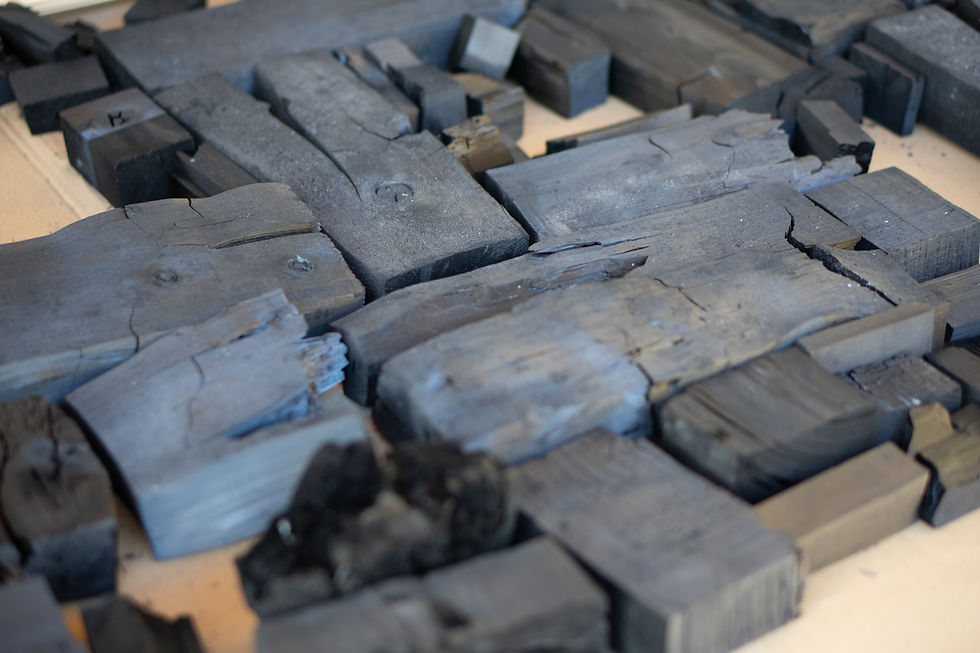
His medium is carbonized hinoki cypress.
Charcoal intended for fuel is typically made from hardwood, valued for its density and stability. After experimenting with bamboo charcoal and binchotan, Hyooogo arrived at a different choice: softwood, particularly hinoki. When carbonized, coniferous wood retains a distinctive fibrous structure, producing a surface quality unlike that of conventional charcoal.

Its appearance is not fixed. Depending on the angle of light, the surface can shimmer with a silver sheen or absorb it into a deep, matte black. It is not simply “black,” but a material that shifts with its surroundings.
The process begins with carbonization. Although controlled by human intervention, the transformation itself is governed by natural forces. Temperature, airflow, and time alter the internal structure of the wood. Cracks and warping occur in ways that cannot be entirely predicted.

Hyooogo does not attempt to eliminate these irregularities. Instead, he incorporates them. The fissures and distortions produced during carbonization become integral to the structural logic of the work.

After carbonization, the material is further sculpted. Through curves and planes, he reveals the inner structure of the wood; at times, he emphasizes linear, artificial elements that contrast with its organic origins.
This layered process defines his practice. A natural material is subjected to a natural transformation through fire, and then shaped by deliberate human intervention. Natural matter, natural phenomena, and human intention accumulate in stages.

Charcoal is ordinarily consumed and reduced to ash. In Hyooogo’s hands, however, it becomes a lasting structure. A material meant to disappear is instead preserved and given form.
Hinoki has long supported Shinto shrines and traditional Japanese spaces. To burn it, carve it, and reconstruct it is not an act of destruction, but a reinterpretation of a historically significant material.
Hyooogo’s work does not privilege nature over human intention, nor intention over chance. It moves between control and acceptance, design and transformation, exploring what the material itself can become.
The marks carved into carbonized hinoki are not traces of ruin, but records of change. His sculptures bring forward the time and structure embedded within the material itself.
Text: Shuichiro Fujita Photo: Shuichiro Fujita, Kooichi Hyooogo


Comments